VMware Alternatives
Take control of your virtualisation future. Assess and test drive available alternatives, select the right hypervisor, and build a clear, low-risk roadmap away from VMware.

Organisations are re-evaluating infrastructure platforms.
Infrastructure decisions increasingly extend beyond selecting a hypervisor. Licensing changes, operational requirements, cloud integration, application modernisation and evolving business needs are causing organisations to reassess their infrastructure platforms.
Private cloud, hybrid cloud and public cloud technologies now provide organisations with more options than ever before when planning future infrastructure environments.
As technology leaders balance performance, resilience, operational efficiency, flexibility and long-term investment decisions, understanding the strengths and trade-offs of each approach becomes increasingly important.
Infrastructure Evaluation Framework
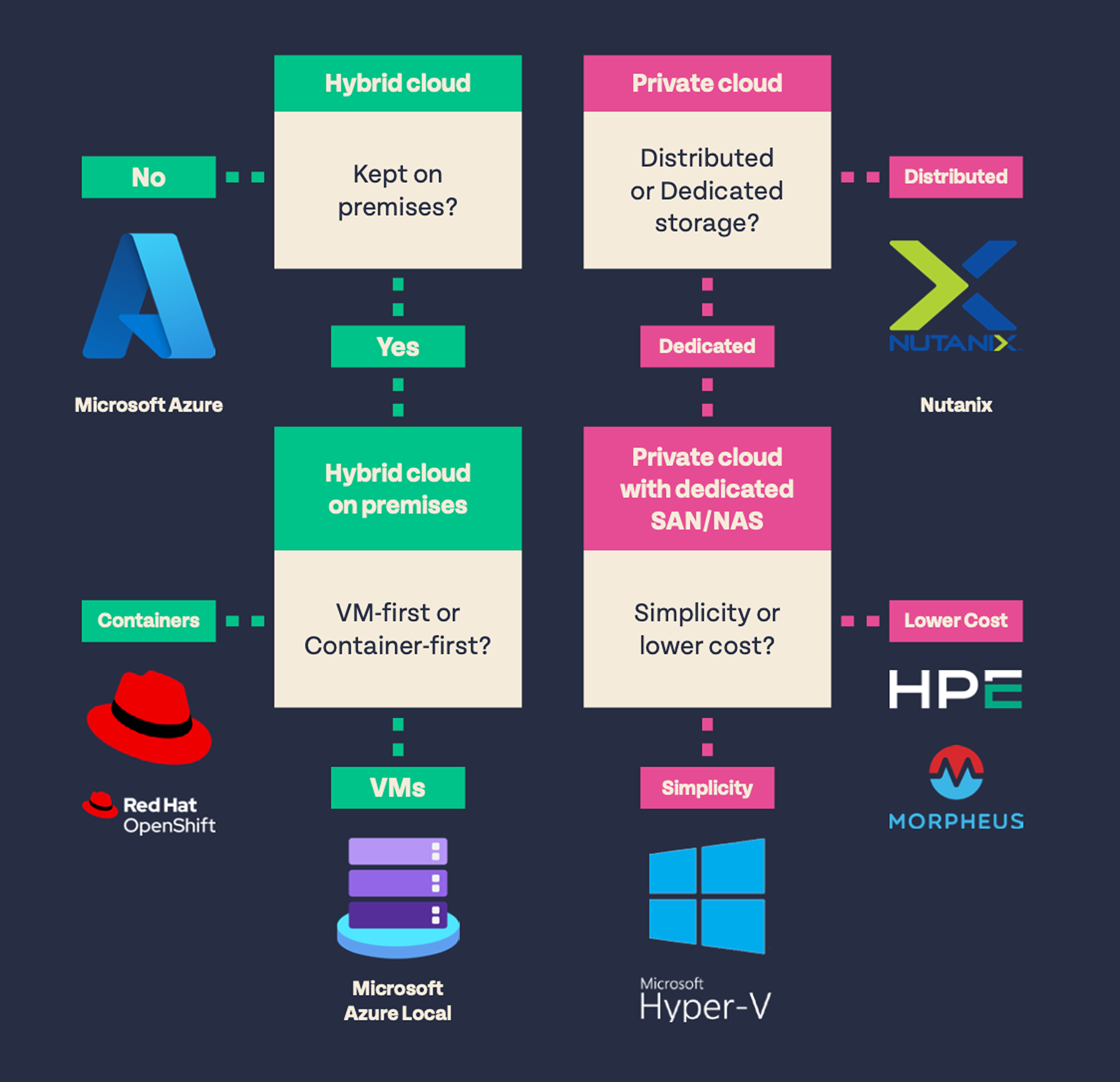
Selecting an infrastructure platform requires balancing application requirements, operational models, cloud strategy and infrastructure architecture. Use the framework below to identify the platforms best aligned to your organisation’s technical, operational and commercial requirements.
Microsoft Azure Local
Azure Local (formerly Azure Stack HCI) is Microsoft’s on-premises and edge infrastructure platform that brings Azure-consistent virtualisation, storage, and management to your own datacentres. It is built on Hyper-V, Storage Spaces Direct, and Failover Clustering, and is managed through the Azure control plane via Azure Arc, letting you run Windows/Linux VMs and Azure Kubernetes Service (AKS) locally while keeping data on-prem.
Azure Local is well suited to organisations seeking Azure-consistent management, governance and hybrid cloud capabilities while maintaining workloads on-premises.
Despite its extensive feature set, Azure Local may be less suitable for organisations requiring fully disconnected operations without Azure control-plane integration.

Red Hat OpenShift Virtualization
Red Hat OpenShift Virtualization is a built-in capability of the Red Hat OpenShift container platform that lets you run and manage virtual machines alongside containers on a single Kubernetes-based platform. It’s built on the open-source KubeVirt project and the KVM hypervisor, treating VMs as Kubernetes-native resources managed through the same APIs, UI, and automation workflows as containers.
OpenShift Virtualization is a well suited to organisations seeking a Kubernetes-native platform capable of supporting both virtual machines and containers. Red Hat’s offering is may be less appropriate for organisations seeking a like-for-like virtualisation experience without adopting Kubernetes operational models.
Microsoft Azure
Microsoft Azure is a public cloud platform that provides infrastructure- as-a-service (IaaS), platform services, and native virtualisation through Azure Virtual Machines. Instead of running your own hypervisor stack, Azure delivers compute, storage, networking, security, and management as cloud services, operated and maintained by Microsoft.
Azure is a suitable replacement for VMware in organisations that want to eliminate on-prem infrastructure management, gain elastic scale and built-in HA/DR, and use familiar VM constructs while benefiting from cloud economics and Azure Hybrid Benefit. It is not a suitable VMware replacement where workloads require low-latency on-prem control, strict data residency without cloud dependency, or where teams expect a like- for-like vSphere operational model rather than a cloud-first one.
Nutanix
Nutanix is a hyperconverged infrastructure (HCI) platform that combines compute, storage, and networking into a single software-defined stack.
It’s typically deployed on standard x86 servers and managed through a single interface (Prism). Nutanix includes its own native hypervisor, AHV, alongside enterprise storage, management, and automation features.
Nutanix works best in environments that prioritise simplified operations, predictable costs, and core virtualisation capabilities, as its AHV hypervisor and integrated HCI stack cover most enterprise needs without separate licensing.

HPE VM Essentials / Morpheus
HPE VM Essentials is a virtualisation platform from HPE built around a KVM-based hypervisor (HPE VME) with unified management powered by Morpheus. It allows organisations to manage both VMware vSphere and HPE’s KVM clusters from a single interface, with built-in tools to gradually migrate workloads away from VMware if desired. HPE VM can be a great fit for organisations that want lower, predictable licensing, unified management of both VMware and KVM from a single control plane, and a gradual, low-risk migration path away from vSphere while retaining core enterprise features like HA and live migration.
It can disappoint in environments that depend heavily on VMware’s deep ecosystem, advanced NSX-level networking, or highly mature third-party integrations, as VME is newer, more hardware-validated, and still evolving in parity with VMware’s most advanced features.
Microsoft Hyper-V
Hyper-V is Microsoft’s enterprise hypervisor built into Windows Server, providing server virtualisation, clustering, and high availability with deep integration into the Microsoft ecosystem. It’s managed through tools like Hyper-V Manager, Windows Admin Center, and System Center.
Hyper-V can replace VMware well in Windows-centric environments where organizations want to reduce licensing costs, leverage existing Windows Server entitlements, and rely on mature features like failover clustering, live migration, and PowerShell-driven automation.
Hyper-V may be less suitable for highly heterogeneous environments requiring advanced software-defined networking or extensive third-party ecosystem integration.
Partners















Talk to a cloud & infrastructure expert
Planning a move off VMware or reviewing your cloud strategy? We’ll walk you through your options and what a phased migration could look like.